What plagiarism means in the age of AI and how to use AI without copying or misrepresenting work.
You finish an assignment, feeling quite proud, then someone asks, “Did you use AI for that?” Suddenly, it feels like a trick question. You did use AI… but only a bit. Now you are wondering if that counts as plagiarism or not. Welcome to one of the most confusing parts of using AI at school.
The Important Stuff
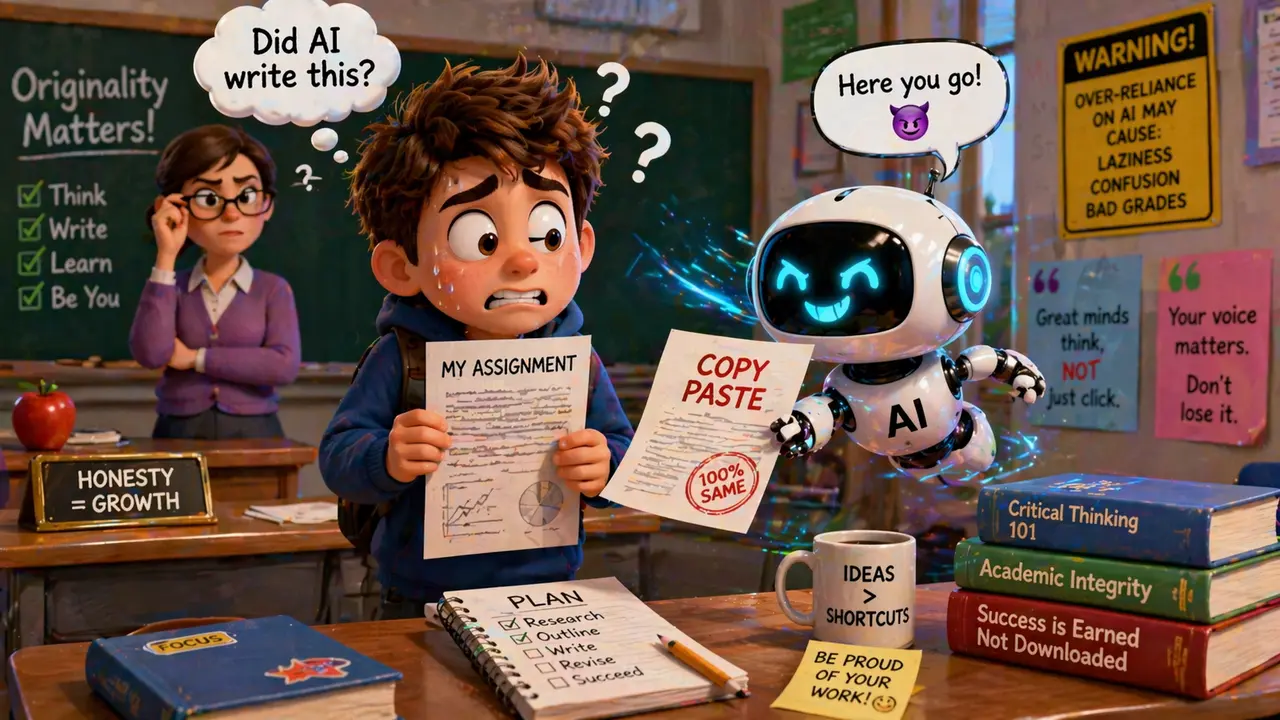
Plagiarism means presenting someone else’s work as your own. With AI, that line gets blurry fast. If you copy and paste an AI-generated answer straight into your assignment, that is not your work. It does not matter that a human did not write it. You are still submitting something you did not create or fully understand.
Using AI properly looks different. You use it to understand a topic, generate ideas, or improve something you have already written. Then you rewrite everything in your own words and make sure you actually understand it. That way, the final work reflects your thinking. The tool helped, but it did not replace you.
Now It’s Your Turn
Here is an example of a prompt you can use right now in an AI chat of your choice. Copy the prompt text below and paste it into an AI chat platform such as ChatGPT, Gemini, Copilot or Claude.
I am a school student working on [insert topic]. Please explain the topic clearly so I can understand it. Then give me a few key ideas I should include in my answer. Do not write the answer for me. I will write my own version and use your explanation to guide me.
Make It Your Own
AI gives you a starting point, not a finished product. The real work happens when you take that information, think about it, and turn it into something that sounds like you. That is how you avoid plagiarism and actually learn at the same time.
Leave a Reply